| dc.contributor.advisor | Hamplová, Lidmila | |
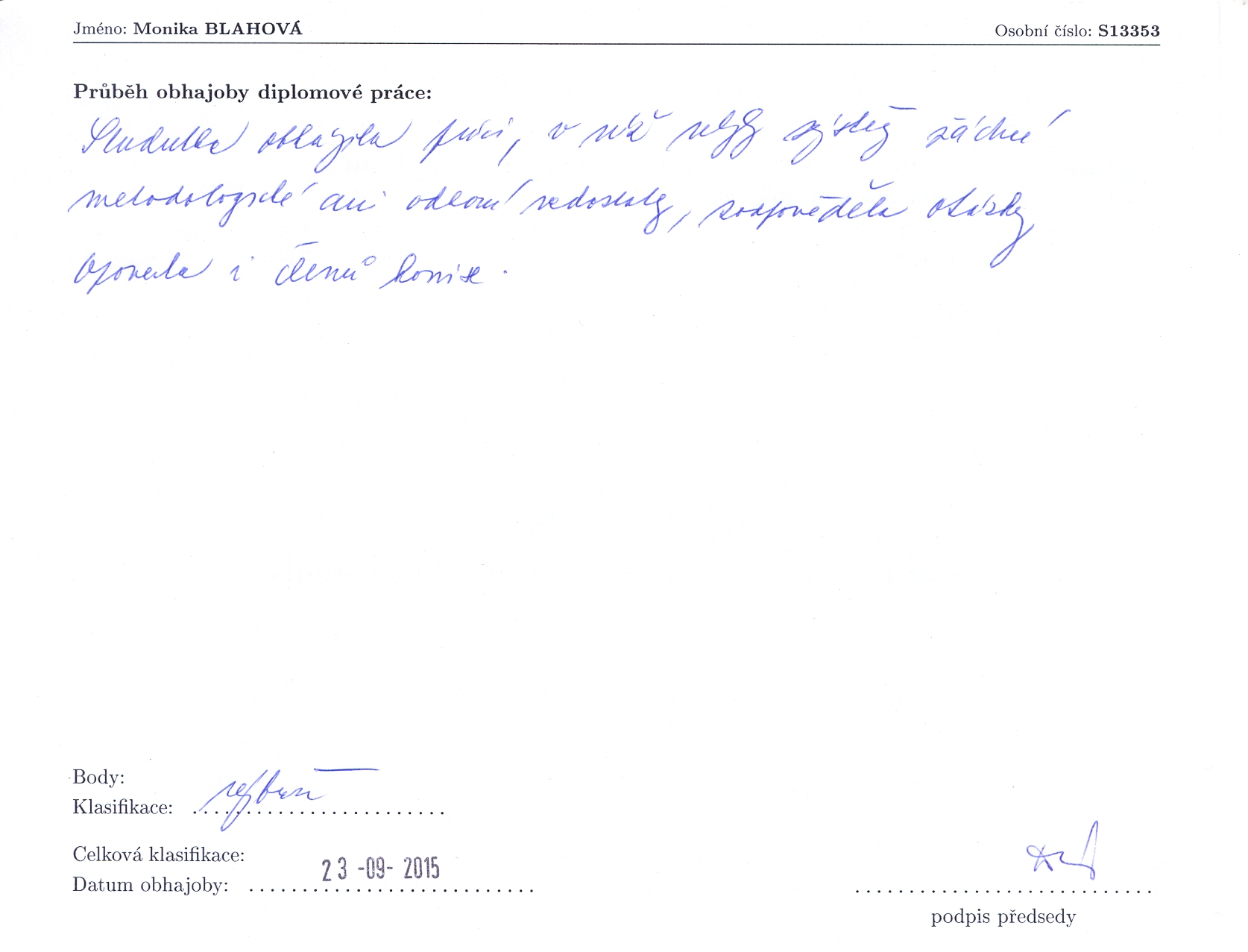
| dc.contributor.author | Blahová, Monika | |
| dc.date.accessioned | 2021-12-03T14:24:54Z | |
| dc.date.available | 2021-12-03T14:24:54Z | |
| dc.date.issued | 2015 | |
| dc.date.submitted | 2015-08-11 | |
| dc.identifier.uri | https://dspace.jcu.cz/handle/20.500.14390/22476 | |
| dc.description.abstract | Téma diplomové práce nese název - ,Problematika kuřáctví studentů středních zdravotnických škol".
Kuřáctví je jednou z nejčastěji se vyskytujících drogových závislostí současné doby v Evropě. Podle Světové zdravotnické organizace ve světě v současnosti kouří 1,3 miliardy lidí, přičemž každý rok následky kouření cigaret usmrtí zhruba 4, 8 milionů lidí, tedy asi 560 osob každou hodinu. Pokud bude současný trend pokračovat aktuálním tempem, tak zemře na následky kouření cigaret v průběhu roku 2020 deset milionů lidí. Kuřáctví vyvolává velkou závislost na nikotinu, která s sebou nese výrazné ekonomické, sociální i zdravotní dopady.
K výzkumným účelům byli vybráni studenti 1. a 4. ročníků prezenční formy studia všech SZŠ Jihočeského kraje. Jednalo se konkrétně o studenty škol: SZŠ a VOŠZ České Budějovice, SOŠZ a SOU Český Krumlov, SZŠ Jindřichův Hradec, SZŠ Tábor a SZŠ Písek. Osloveno bylo celkem 591 studentů. Kompletně vyplnilo dotazník 500 respondentů, z čehož převážnou většinu tvořily dívky (87 %). Průměrný věk dotazovaných byl 17 let.
Diplomová práce je složena z teoretické a empirické části.
Teoretická část se zabývá historií kuřáctví cigaret, definicí drogové závislosti, chemickým složením cigaretového kouře a škodlivostí jednotlivých toxických složek. Dále je v teoretické části věnována kapitola problematice kouření elektronické cigarety. V závěru této části práce jsou uvedeny vybrané statistické údaje vztahující se ke kouření cigaret. Jsou zde shrnuty poznatky celé řady autorů zabývajících se problematikou kuřáctví cigaret a závislosti na nikotinu.
Empirickou část tvoří vlastní poznatky z rozboru výzkumu, který byl proveden se záměrem zmapovat prevalenci kuřáctví u budoucích zdravotníků a jejich názor na kouření cigaret u zdravotnického personálu a osob připravujících se na výkon zdravotnického povolání. Jsou zde uvedeny názory a postoje respondentů.
Cílem práce bylo jednak:
1.: Zjištění prevalence kuřáctví u studentů 1. a 4. ročníků SZŠ.
2.: Zjištění, jaký vliv má nejbližší okolí respondentů na skutečnost, že kouří.
3.: Zjištění, jaký postoj mají studenti zdravotnických škol ke kouření cigaret u pracovníků v oblasti zdravotnictví.
K dosažení výše uvedených cílů byly stanoveny tři hypotézy:
H1: Existuje statisticky významný rozdíl v prevalenci kuřáctví cigaret u studentů
1. a 4. ročníku SZŠ.
H2: Existuje statisticky významný rozdíl ve výskytu kuřáctví cigaret u studentů
pocházejících z rodin, ve kterých alespoň jeden člen rodiny kouří
a z nekuřáckých rodin.
H3: U studentů 1. a 4. ročníků SZŠ existují statisticky významné rozdíly v postoji
ke kouření cigaret u zdravotnických pracovníků.
Za účelem potvrzení nebo vyvrácení stanovených hypotéz byla zvolena metoda kvantitativního výzkumu. Pro sběr dat byl použit dotazník. Dotazníky, jež obsahovaly 23 otázek, byly rozdány mezi 591 studenty SZŠ Jihočeského kraje. Jejich návratnost byla téměř 85 %. Získaná data byla zpracována v podobě přehledných grafů a hypotézy byly statisticky otestovány.
Na základě vyhodnocení odpovědí respondentů se statistickým otestováním získaných dat potvrdila první hypotéza, která předpokládala, že existují statisticky významné rozdíly ve výskytu kuřáctví cigaret u studentů 1. ročníku a maturanty. Rozdíl skutečně existuje, podle výzkumu studenti 4. ročníku kouří častěji. Zajímavé je, že největší rozdíl je u SZŠ a VOŠZ České Budějovice. Naopak u studentů SOŠZ Český Krumlov je procento kuřáků již v 1. ročníku velmi vysoké.
Hypotéza č. 2 byla také statisticky potvrzena. Zde existuje skutečně významný rozdíl, přičemž největší výskyt je u pravidelných kuřáků, tzn. v rodinách, kde minimálně jeden člen kouří, je sklon ke kuřáctví potomků výrazně vyšší. Navíc pravidelný kuřák pocházející z rodiny kuřáků vykouří více cigaret. U příležitostných kuřáků nejsou rozdíly tak velké a netýkají se ani intenzity kouření.
Ani poslední hypotéza nebyla vyvrácena. Významné rozdíly se vyskytly ve všech t | cze |
| dc.format | 107 s. (136 319 znaků) | |
| dc.format | 107 s. (136 319 znaků) | |
| dc.language.iso | cze | |
| dc.publisher | Jihočeská univerzita | cze |
| dc.rights | Bez omezení | |
| dc.subject | kuřáctví
závislost
cigareta
nikotin
elektronická cigareta
nikotinové náhražky | cze |
| dc.subject | smoking
addiction
cigarette
nicotine
electronic cigarette
nicotine substitute | eng |
| dc.title | Problematika kuřáctví studentů středních zdravotnických škol | cze |
| dc.title.alternative | Aspects of smoking among students of high medical school. | eng |
| dc.type | diplomová práce | cze |
| dc.identifier.stag | 43251 | |
| dc.description.abstract-translated | The thesis topic bears the name: "Aspect of smoking among students of high medical schools".
Smoking is one the most often appearing drug addictions nowadays in Europe. With reference to the World Health Organization, there are 1.3 billion of smoking people in the world today whereas consequences of smoking kill approximately 4.8 million of people every year, which are 560 people each hour. If the current trend continues, then in the current pace 10 million of people will die of the consequences of cigarette smoking during the year of 2020. Smoking invokes an enormous addiction to nicotine which bears itself considerable economic, social and health problems.
There were some students from 1st and 4th grade of the present form of studies of all high medical schools selected. Those were students particularly from the schools: SZŠ and VOŠZ České Budějovice, SOŠZ and SOU Český Krumlov, SZŠ Jindřichův Hradec, SZŠ Tábor and SZŠ Písek. In total, 591 of students were responded whereas most of them were girls (87%). The average age of the responded ones was 17 years.
The thesis consists of theoretical and empirical parts.
The theoretical part deals with history of cigarette smoking, a definition of drug addiction, chemical composition of cigarette smoke and malignity of individual toxic elements. Further, there is a chapter concerning problem issues of electronic cigarette smoking in the theoretical part. In the conclusion of this part of the thesis, there are some statistical data referring to cigarette smoking stated. There are some findings of quite a few of authors dealing with problem issues of cigarette smoking and addiction to nicotine summarized here.
The empirical part consists of findings from my own research analysis which was done with the intention to map the prevalence of smoking among future health workers and their opinion to cigarette smoking among healthcare staff and people preparing for their healthcare career. There are also the respondents' opinions and attitudes included.
The aim of the thesis was:
1.: To find the prevalence of smoking of 1st and 4th grade of high medical schools
students.
2.: To find what influence the respondents' surroundings have on the fact of their
smoking.
3.: To find what attitude high medical school students have to healthcare staff
smoking cigarettes.
To reach the above mentioned aims, there were three hypotheses determined:
H1: There is a statistically significant difference existing in the prevalence of
smoking at 1st and 4th grade of high medical school students.
H2: There is a statistically significant difference existing in the prevalence of
cigarette smoking among students coming from families where at least one member
smokes.
H3: There are statistically significant differences in the attitude of 1st and 4th grade
students to cigarette smoking among healthcare workers.
To prove or disprove the mentioned hypotheses there is a method of quantitative research selected. A questionnaire was used to collect the data. The questionnaires including 23 questions were distributed among 591 students of high medical schools of the South Bohemia Region. Their rate of return was 85%. The collected data were processed in the form of transparent graphs and the hypotheses were statistically tested.
Pursuant to the evaluation of respondents' answers including the statistical data testing were proved by the hypothesis which presumed that there were statistically significant differences in the prevalence of cigarette smoking 1st and 4th grade students. The difference really exists that the 4th grade students smoke more often. It is interesting that the most considerable difference is between the schools of SZŠ and VOŠZ České Budějovice. On the contrary, the percentage of smoking students of SOŠZ Český Krumlov in the 1st grade is considerably high.
Hypothesis no. 2 was statistically proved as well. There is a real significant difference exist | eng |
| dc.date.accepted | 2015-09-23 | |
| dc.description.department | Zdravotně sociální fakulta | cze |
| dc.thesis.degree-discipline | Odborný pracovník v ochraně veřejného zdraví | cze |
| dc.thesis.degree-grantor | Jihočeská univerzita. Zdravotně sociální fakulta | cze |
| dc.thesis.degree-name | Mgr. | |
| dc.thesis.degree-program | Veřejné zdravotnictví | cze |
| dc.description.grade | Dokončená práce s úspěšnou obhajobou | cze |
| dc.contributor.referee | Filka, Jozef | |